
'Boris Godunov' review — Bryn Terfel is extraordinary as a man visibly tortured by his crime
Read our review of Modest Mussorgsky's Boris Godunov, directed by Richard Jones, now in performances at the Royal Opera House to 18 February.
Summary
- Richard Jones's production of Boris Godunov returns to the Royal Opera House
- Bryn Terfel gives a compassionate performance as the tortured title character
- The orchestra is conducted brilliantly by Mark Wigglesworth
- Miriam Buether's multipurpose set is highly effective

Before Richard Jones’s production of Boris Godunov even begins, a large painting of a child’s multicoloured spinning top covers the opening curtain. It is an image that returns as a kind of waking nightmare as the opera grows in intensity, as we witness the murder of the young Tsarevich Dmitry, struck down while playing with the spinning top. Throughout the evening the image is replayed maniacally, again and again.
Based on the real Russian ruler, the story follows Boris Godunov as he is crowned Tsar. Yet his path to the throne is far from honourable, marked by the killing of Dmitri. Guilt seeps into every moment of his rule, as Modest Mussorgsky’s opera unfolds as a warning against ruthless ambition and its inescapable moral cost.
This revival of Jones’s production sees Bryn Terfel return to the title role of Boris. On the Royal Opera House stage he appears as a man visibly tortured by his crime. From an initially regal state, he gradually crumbles into madness, seeing second meanings in everything and begging God for forgiveness at every opportunity. His fall from grace is the nucleus of the drama, with his growing unease seemingly etched more deeply across his brow with each successive scene. More than ever, the story reveals the dark and corrupting force of power. And yet, Terfel plays Boris with such compassion that we cannot help but pity him by the end.
Jones’s version returns Mussorgsky’s historical epic to its original 1869 form, with the seven scenes played straight through without an interval. This gives the evening a propulsive quality, each tableau bleeding seamlessly into the next. Conducted brilliantly by Mark Wigglesworth, the often ominous, clattering score leans fully into its contrasts of light and shade. From Boris’s early, gleaming coronation, it slips into darker, more brooding territory. The beauty here lies in the variety.
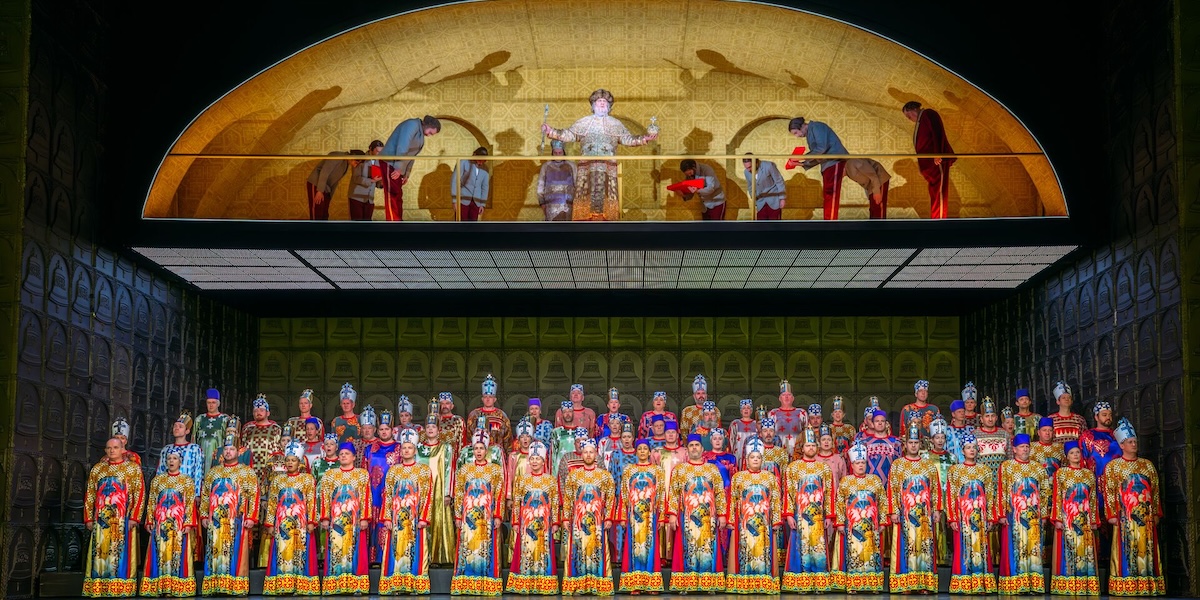
Miriam Buether’s multipurpose set works best when it draws sharp class distinctions across its layers. The upper level, washed in bright yellow, keeps the Tsar and the Boyars (aristocrats) removed from the crowds below. Beneath them, figures dressed in greys and browns plead for food and fairness. Brought vividly to life by an excellent, rousing chorus, it presents a bleak picture of social division.
This carefully chosen colour palette remains central throughout. At Boris’s coronation, the stage sings with golden jewels, erupting in splendour and ceremonial lustre. By contrast, the Chudov Monastery is rendered in far more subdued hues. With church bells sketched into the brickwork of the set, the reminder of God’s judgement hangs over every scene. Yet the design is always purpose-driven, never overpowering the action. What remains is a production that hones in relentlessly on the emotional and spiritual weight of Russian life.
While we know Boris’s reign as Tsar can never end happily, Jones somehow makes us will it to succeed. With its mix of clashing chords and spine-chilling arias, the opera shows the hope surrounding the Tsar falling apart piece by piece. In his final, dying breaths, clutching his son in pain, the weight of the crown seems heavier than ever.
Boris Godunov is at the Royal Opera House to 18 February. Book Boris Godunov tickets on LondonTheatre.co.uk
Photo credit: Boris Godunov (Photos by Mihaela Bodlovic)
Originally published on
Latest News
- 1
'Les Misérables' tickets available through October 2027
- 2
'Mamma Mia! The Party' tickets now available through 2027
- 3
Full casting announced for Andrew Barth Feldman-led 'Nero'
- 4
'Titanique' announces closing in the West End
- 5
Full cast announced for 'Cloud 9' at the National Theatre
- 6
First cast revealed for reimagined one-part 'Harry Potter and the Cursed Child' in the West End
- 7
Amber Davies to star in West End run of 'Legally Blonde The Musical'
- 8
New casting announced for 'Witness for the Prosecution'
- 9
'My Neighbour Totoro' announces closing date in the West End
- 10
'Sunday in the Park with George' London revival cancelled
Subscribe to our newsletter to unlock exclusive London theatre updates!
- Get early access to tickets for the newest shows
- Access to exclusive deals and promotions
- Stay in the know about news in the West End
- Get updates on shows that are important to you
You can unsubscribe at any time. Privacy Policy