

Learn about Ralph Fiennes's career ahead of 'Grace Pervades'
The Tony Award winner and three-time Oscar nominee returns to the West End in April 2026 in David Hare's historical play Grace Pervades.
Summary
- Fiennes began his career at Regent's Park Open Air Theatre; the National Theatre and the Royal Shakespeare Company
- He won a Tony for Hamlet in 1995
- He has played most of the major Shakespearean roles and numerous other classical and contemporary parts
- Fiennes returns to the West End to play Victorian actor Henry Irving in David Hare's latest play
Known for his intense performances, often in villainous roles, Ralph Fiennes was born in Ipswich, Suffolk in 1962. His brother is the actor Joseph Fiennes and his sister is the filmmaker Martha Fiennes. He attended the Chelesa College of Art before training at RADA. To date, he has earned a Tony Award, a BAFTA (and six further nominations), two Evening Standard Theatre Awards, and three Oscar nominations.
Fiennes made his film debut as Heathcliff in Emily Brontë's Wuthering Heights in 1992. He came to further prominence as Nazi concentration camp guard Amon Göth in Steven Spielberg’s Schindler’s List, for which he won aa BAFTA for Best Supporting Actor and was nominated for an Oscar.
Fiennes was directed by the late Robert Redford in the 1950s-set mystery Quiz Show and was nominated for his second Oscar for his role as Count László Almásy in Anthony Minghella’s romantic epic The English Patient (1995). Other roles during the ‘90s included the costume dramas Oscar and Lucinda, Onegin, and The End of the Affair.
He played Voldemort in four instalments of the Harry Potter franchise between 2005-11. Further notable films have included The Constant Gardener, In Bruges, The Reader, A Bigger Splash, Hail Caesar, and The Menu.
He memorably had the chance to showcase his lighter side as flamboyant concierge Monsieur Gustave in Wes Anderson’s The Grand Budapest Hotel and has so far played Gareth Mallory / M in three James Bond films: Skyfall, Spectre, and No Time to Die. He has also turned to directing with Coriolanus (2011), The Invisible Woman (2013), and The White Crow, in which he played the titular Roman general, Charles Dickens, and ballet master Alexander Pushkin respectively.
Fiennes’s recent screen roles include Cardinal Thomas Lawrence in papal thriller Conclave (his third Oscar nomination), Odysseus in the Homeric epic The Return, and Dr Ian Kelson in Danny Boyle’s post-apocalyptic horror 28 Year Later. At the end of 2025, he played a choir master in Alan Bennett’s Word War I-era drama The Choral (directed by Nicholas Hytner) and in 2026, he will be seen in 28 Years Later: The Bone Temple and as Coriolanus Snow in The Hunger Games: Sunrise on the Reaping.
In addition to his prolific film work, Fiennes has always made time for theatre appearances, especially in the works of Shakespeare. Next year, Fiennes returns to the West End in Grace Pervades, playing Victorian actor Henry Irving. Read on to learn more about his theatre work to date – is there any other film star who is as committed to the theatre? As LondonTheatre.co.uk’s reviewer observed when he played Richard III: “Fiennes is one of the most loyal of all [major actors] to the stage. It's his true home”.
Book Grace Pervades tickets on LondonTheatre.co.uk.
Regent’s Park Open Air Theatre (1985-86)
Fiennes began his career at the enchanting Regent’s Park Open Air Theatre, then under the artistic directorship of David William (with Ian Talbot taking over in '87). During his first season, he played the small roles of Curio in Twelfth Night, Cobweb in A Midsummer Night’s Dream, and Footman in Ring Round the Moon. In his second year, he was promoted to Lysander in Dream (Hugh Bonneville – then known as Richard – was his alternate) and played Romeo in Romeo and Juliet (opposite Sarah Woodward, who’s now an acclaimed character actress, and directed by Declan Donnellan).
National Theatre (1987)
Fiennes proceeded to the National Theatre, where he played the Son in Six Characters in Search of an Author, Arkady Nikolayevich Kirsanov in Fathers and Sons (adapted by Brian Friel), and Lisha Ball in Ting Tang Mine. His castmates included Barbara Jefford, Lesley Sharp, and Robert Glenister.
Royal Shakespeare Company (1987-1991)
Following his season at the National, Fiennes joined the Royal Shakespeare Company. First up, he played the Dauphin in King John and Claudio in Much Ado About Nothing, followed by the title role in Henry VI, Edmund in King Lear, Berowne in Love’s Labour’s Lost, and Troilus in Troilus and Cressida. In these productions, his fellow actors included Simon Russell Beale, Paterson Joseph, Amanda Root, and Alex Kingston, to whom he was married between 1993-97.
Hamlet (1995)
After making his name on the big screen, Fiennes returned to the stage as the Prince of Denmark, directed by Jonathan Kent and produced by the Almeida Theatre at the Hackney Empire. The cast included Damian Lewis as Laertes, Tara Fitzgerald as Ophelia, and Francesca Annis as Gertrude.
When the production transferred to Broadway, the New York Times described Fiennes’s Hamlet as “utterly contemporary in execution and concept, even to the downtown manner in which he wears his Edwardian clothes”. He won a Tony for his performance.
Ivanov (1997)
Fiennes and Kent continued their association on Chekhov’s early play, alongside Harriet Walter and Oliver Ford Davies. The production also briefly toured to Moscow, where it became the first foreign staging of a Chekhov play to be staged in the city.
Coriolanus and Richard II (2000)
Prior to being rebuilt as flats, the derelict Gainsborough Studios (where Alfred Hitchcock made some of his early films) by the Regent’s Canal in Hackney played host to productions of Coriolanus and Richard II, both starring Fiennes in the title roles and directed by Jonathan Kent. The industrial dilapidation of the venue was, for the time, an unusual environment in which to present Shakespeare. The company also featured Barbara Jefford, Linus Roache, and Emilia Fox.
The Talking Cure (2002)
Fiennes played psychologist Carl Jung in Christopher Hampton’s play about the relationship between Jung and Sigmund Freud (Dominic Rowan) at the National Theatre’s intimate Cottesloe Theatre. LondonTheatre.co.uk’s reviewer commented: “Fiennes bubbles with energy and agitation, expressing the forcefulness of an intellect struggling to find the ideas with which to express its growing insights. One can sense his shame towards his wife to whom he was unfaithful and feel his pain as he foresees the coming strife across Europe”.
Brand (2003)
Fiennes portrayed Ibsen’s zealous Lutheran preacher in Adrian Noble’s RSC production. When it transferred to the West End, LondonTheatre.co.uk’s reviewer noted that “Fiennes' Brand has moments of self-doubt about the path he has chosen, but because of his lack of vision they appear false, and leave you with little doubt as to which action he will choose.”
Julius Caesar (2005)
Fiennes took the role of Mark Antony in Deborah Warner’s production of the Roman play as part of an ensemble that included Simon Russell Beale as Cassius and Fiona Shaw as Portia. The large-scale staging at the Barbican included an ensemble of 100 and was hailed as a production for the age of Bush and Blair.
Faith Healer (2006)
Fiennes returned to Broadway for a revival of Brian Friel’s 1979 three-hander directed by Jonathan Kent. He played the titular faith healer Francis Hardy, with Cherry Jones as his wife Grace and Ian McDiarmid as stage manager Teddy. Fiennes was nominated for a Tony and McDiarmid took home Best Featured Actor in a Play.
God of Carnage (2008)
The West End premiere of Yasmina Reza’s dark comedy of manners starred Fiennes, Tamsin Greig, Ken Stott, and Janet McTeer as two sets of parents brought together following a playground fight between their sons. LondonTheatre.co.uk’s reviewer stated that: “The quality of the acting here is superb with all the team turning in exceptionally strong, definitive performances. Ralph Fiennes is the cynical lawyer who calmly states that his son is 'a savage', yet collapses into catatonic shock when his mobile phone is 'disfigured' by his wife.”
Oedipus (2008)
Fiennes returned to the National Theatre to play the title role in Sophocles’ tragedy adapted by Frank McGuinness and directed by Jonathan Kent, which earned strong reviews for its sharp modern setting and the humanity with which Fiennes imbued the doomed king.
The Tempest (2011)
At 49, Fiennes was a relatively young Prospero in Shakespeare’s last play. Directed by Trevor Nunn, LondonTheatre.co.uk’s reviewer commented that “Fiennes is a very serious and extremely deliberate Prospero… he makes us believe that he has magical powers when he mutters and mumbles spells under his breath, especially before he conjures up the sea storm”.
Man and Superman (2015)
Fiennes played Jack Tanner, a "political firebrand and confirmed bachelor, in Simon Godwin’s modern-dress production of Bernard Shaw’s 1903 four-act play at the National Theatre. LondonTheatre.co.uk’s reviewer described Fiennes as “a natural-born stage star who completely owns the stage as he prowls it with urgency and conviction”.
The Master Builder (2016)
According to LondonTheatre.co.uk's reviewer, Fiennes was perfectly cast as Ibsen’s architect in Matthew Warchus’s production at the Old Vic: “It's a fantastic star role for Ralph Fiennes, who has been returning to the theatre with a vengeance and is not shy of a challenge… The bearded Fiennes has always had a brooding intensity; here he puts it to fine use for a man haunted by fear and guilt”. Sarah Snook (Succession, The Picture of Dorian Gray) made her London stage debut as Hilda Wangel, the young woman with whom Fiennes’s character has a prior history.
Richard III (2016)
No one could accuse Fiennes of slacking in his theatre appearances – the notorious monarch was his third stage role in 18 months. The production was directed by Rupert Goold and featured Vanessa Redgrave as Queen Margaret. LondonTheatre.co.uk’s reviewer was delighted by Fiennes’s performance: “Gruesomely compelling, bringing unexpected gallows humour and real violence to the role”.
Antony and Cleopatra (2018)
After playing Mark Antony in Julius Caesar over a decade previously, Fiennes starred in its sequel of sorts opposite Sophie Okonedo’s Cleopatra at the National Theatre, directed by Simon Godwin. LondonTheatre’s reviewer observed: “Together, they bring a ferocious, impassioned urgency to the couple’s passionate and violent co-dependent relationship”.
Straight Line Crazy (2022)
During the pandemic, Fiennes gave a one-man performance in David Hare’s Beat the Devil at the Bridge Theatre, based on Hare’s own experiences of contracting Covid-19. Two years later, he returned to the Bridge in Hare’s play about controversial 1950s New York city planner Robert Moses. The production transferred to Off Broadway’s The Shed.
Macbeth (2023)
Fiennes’s most recent Shakespeare role was the titular Scottish king, opposite Indira Varma as his Lady. The production was directed by Emily Burns and staged at the industrial Dock X performance space. LondonTheatre.co.uk’s reviewer observed that he played Macbeth “as a befuddled older man… he masters Shakespeare’s language with perfectly precise diction, eliciting chuckles from the audience with his wry humour”.
Grace Pervades (2026)
In summer and autumn 2025, Theatre Royal Bath presented the “Ralph Fiennes” season. Firstly, he starred in David Hare’s Grace Pervades, before directing As You Like It. This month, he appears in Rebecca Lenkiewicz’s Small Hotel, with Francesca Annis, Rosalind Eleazar, and Rachel Tucker.
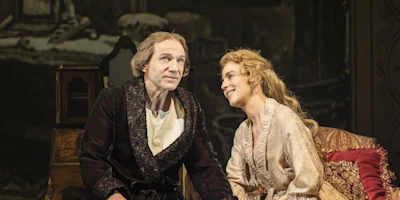
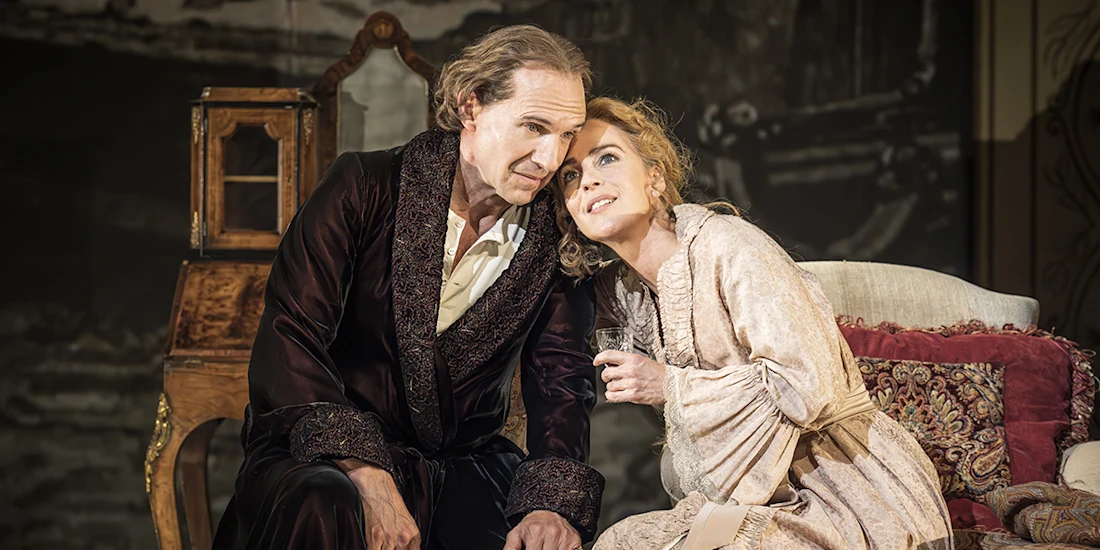
In April 2026,Grace Pervades transfers to the Theatre Royal Haymarket for a limited run. Fiennes plays Henry Irving, the most acclaimed actor of the mid-to-late Victorian era and the first actor to be knighted. He had a long working relationship with the equally celebrated Ellen Terry, which may or may not have been strictly professional. Miranda Raison (Spooks, Anne Boleyn) plays Terry and the production is directed by Jeremy Herrin (People, Places and Things). The story is fascinating and Irving and Fiennes surely have a considerable amount in common.
Book Grace Pervades tickets on LondonTheatre.co.uk.
Frequently asked questions
What is Grace Pervades about?
Step back into the world of Victorian Theatre with Grace Pervades, David Hare’s elegant new play about Henry Irving, Ellen Terry, and the story that shaped British Theatre. The production boasts performances by Academy Award-nominee Ralph Fiennes and the wonderful Miranda Raison.
What's the age recommendation for Grace Pervades?
The recommended age for Grace Pervades is Ages 12+..
Where is Grace Pervades playing?
Grace Pervades is playing at Theatre Royal Haymarket. The theatre is located at 18 Suffolk St, London, SW1Y 4HT.
How long is Grace Pervades?
The running time of Grace Pervades is 2hr 30min. Incl. 1 Interval
How do you book tickets for Grace Pervades?
Book tickets for Grace Pervades on London Theatre.
Who wrote Grace Pervades?
David Hare wrote the play.
Who directed Grace Pervades?
Jeremy Herrin is the director.
Is Grace Pervades appropriate for kids?
Grace Pervades is best for those ages 12 and above. Children under 5 will not be admitted, and anyone under 16 must be accompanied by an adult.
Is Grace Pervades good?
Grace Pervades is a play for those who thoroughly enjoy the theatre, as well as those who are interested in its history.This can't miss production is strong in its staging, writing, and direction, and pulls smashing performances from its brilliant cast.
Originally published on
Latest News
- 1
'Titanique' announces closing in the West End
- 2
First cast revealed for reimagined one-part 'Harry Potter and the Cursed Child' in the West End
- 3
Amber Davies to star in West End run of 'Legally Blonde The Musical'
- 4
New casting announced for 'Witness for the Prosecution'
- 5
'My Neighbour Totoro' announces closing date in the West End
- 6
'Sunday in the Park with George' London revival cancelled
- 7
Complete cast set for 'The Jungle Book' at the National Theatre
- 8
StarKid musical 'Nerdy Prudes Must Die' to play in the West End
- 9
Charlotte d'Amboise to join Jesse Tyler Ferguson in 'Tru' at the Menier Chocolate Factory
- 10
Get to know the new cast of 'Hadestown'
Related articles
Subscribe to our newsletter to unlock exclusive London theatre updates!
- Get early access to tickets for the newest shows
- Access to exclusive deals and promotions
- Stay in the know about news in the West End
- Get updates on shows that are important to you
You can unsubscribe at any time. Privacy Policy