

Learn about the real history of 'Grace Pervades'
David Hare's new play stars Ralph Fiennes and Miranda Raison as legendary performers Henry Irving and Ellen Terry.
Summary
- David Hare's new play Grace Pervades is coming to the West End
- The production stars Ralph Fiennes and Miranda Raison
- They play real-life theatrical titans Henry Irving and Grace Terry
- The pair were legendary performers in the Victorian era
It is always riveting to take a peek behind the curtain, which is why we love plays and musicals that take place backstage. In the case of David Hare’s Grace Pervades, which is coming to the West End following an acclaimed premiere in Bath, we also get a fascinating portrait of two theatre legends from the Victorian era: Henry Irving and Ellen Terry.
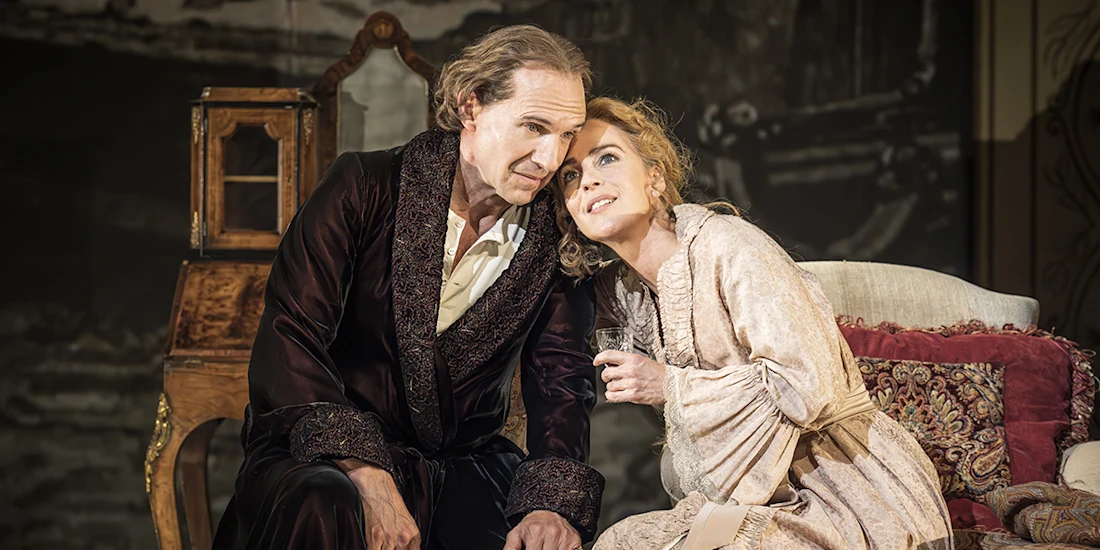
That celebrated pair are played by another impressive duo, Ralph Fiennes and Miranda Raison, in a production directed by Jeremy Herrin and playing at the Theatre Royal Haymarket. But just who were Irving and Terry, and what can we learn about their lives and careers through this show? Read on to find out ahead of your trip.
Book Grace Pervades tickets on LondonTheatre.co.uk

Who was Henry Irving?
Sir Henry Irving was a celebrated actor-manager. He made his London stage debut in 1856, playing Romeo in Romeo and Juliet in the West End, at the age of 18, and went on to join a company in Sunderland – although he did suffer some initial setbacks, either through stage fright or because his childhood speech impediment returned.
But he soon built up an impressive body of work, appearing in almost 400 plays in Sunderland and then Edinburgh, including numerous Shakespearean roles. In 1866 he was engaged by the St James’s Theatre in London, and the following year he played Petruchio opposed Ellen Terry as Catherine in an abridged version of The Taming of the Shrew.
Irving became a true popular success in 1872 as a haunted murderer in The Bells, and cemented that with a celebrated Hamlet. In 1878 Irving took over the theatre where he had made his name, London’s Lyceum, becoming a legendary actor-manager in the process, thanks partly to his leading lady, Terry. Oddly, the future Dracula author Bram Stoker also acted as his business manager.
The Lyceum became a flourishing venue under his stewardship, staging both comedy and drama, canonical works and new ones, all with beautifully designed, lavish productions. Irving also took the company on tour in America, to great success. In 1895 he became the first actor to be knighted. However, the Lyceum eventually closed in financial disarray and was sold: it became a music hall. It has since, of course, been restored as a grand theatre and has been home to *The Lion King* since 1999.

Who was Ellen Terry?
Dame Ellen Terry was one of the leading actresses of her generation. She was born into a performing family: her parents met while working in the same company, and her father coached Terry and her siblings in diction. Terry made her stage debut aged nine in The Winter’s Tale, and continued working throughout her childhood.
In 1862 Terry joined a company in Bristol, and then the following year she played Titania in A Midsummer Night's Dream in the newly opened Theatre Royal Bath. She had a hiatus in her career when she married the much older artist George Frederic Watts, although she did become an inspiration for many Pre-Raphaelite artists and the likes of Oscar Wilde.
The marriage ended in social ruin for Terry when she stayed overnight with a recent widower, Edward William Godwin, claiming he had been ill. She subsequently entered into a scandalous relationship with Godwin and the pair had two children. Sadly that romance ended in heartbreak, but she soon married again, to actor Charles Clavering Wardell.
Terry gradually rediscovered her love of acting in the 1870s, winning praise for roles like Portia in The Merchant of Venice at the Prince of Wales’s Theatre. In 1878 Irving engaged her at the Lyceum as his leading lady, and she played a succession of acclaimed roles, such as Ophelia in Hamlet and Beatrice in Much Ado About Nothing, which crowned her as the best Shakespearean actress in Britain. Hare’s play title is drawn from a review that perhaps sums up her complex contemporary reputation: “Grace pervades the hussy”.

Did Irving and Terry have a relationship?
That is the tantalising question for historians, and also for theatre audiences as they watch Grace Pervades play out. There is no doubt that they had an extraordinary creative relationship, with Irving acting as a mentor to the younger Terry, and the pair eventually becoming a powerhouse duo on stage and off.
Terry herself suggested that they had been romantically involved, saying “We were terribly in love for a while”. But as well as her complex personal life, which included two illegitimate children, Irving was married to someone else: his wife Florence refused to grant him a divorce and kept their two children from him. Irving did become godfather to Terry’s children, and he exchanged tender letters with her.
Who were Terry’s children?
Grace Pervades also introduces us to Terry’s son, Edward Gordon Craig, and daughter, Edith Craig, as Hare brings the action from the Victorian era all the way up to the 1960s.
Edward was a pioneering theatre architect who conceived of a new stripped-back form of stagecraft: simplified sets with shafts of light, and perhaps even no actors at all. It was the polar opposite of the ethos that drove Irving’s entire career, so encapsulates the generational conflicts in a changing British theatre.
Edith was a dedicated costume-maker who later produced and mounted her own shows at the converted barn Terry bought in Kent, Smallhythe Place. These shows were vehicles for her remarkable campaigning work as a political and feminist activist. It’s another intriguing way in which the next generation shaped their theatrical inheritance to suit new visions and aims.

Who stars in Grace Pervades?
The play is led by Ralph Fiennes as Irving. The iconic Tony and BAFTA-winning stage and screen actor has done everything from Schindler’s List, The English Patient and the Harry Potter and James Bond films to stage roles in productions such as Hamlet, God of Carnage, Oedipus, The Master Builder, Antony and Cleopatra, and Macbeth.
Playing Ellen Terry is another versatile stage and screen performer, Miranda Raison. Her TV and film projects include Match Point, Spooks, My Week with Marilyn, Murder on the Orient Express, and Warrior, while on stage she originated roles in Howard Brenton’s Anne Boleyn and Jez Butterworth’s The River, and played Hermione opposite Kenneth Branagh and Judi Dench in The Winter’s Tale.
Book Grace Pervades tickets on LondonTheatre.co.uk
Photo credit: Ralph Fiennes and Miranda Raison in Grace Pervades at Theatre Royal Bath (Photos by Marc Brenner)
Frequently asked questions
What is Grace Pervades about?
Step back into the world of Victorian Theatre with Grace Pervades, David Hare’s elegant new play about Henry Irving, Ellen Terry, and the story that shaped British Theatre. The production boasts performances by Academy Award-nominee Ralph Fiennes and the wonderful Miranda Raison.
What's the age recommendation for Grace Pervades?
The recommended age for Grace Pervades is Ages 12+..
Where is Grace Pervades playing?
Grace Pervades is playing at Theatre Royal Haymarket. The theatre is located at 18 Suffolk St, London, SW1Y 4HT.
How long is Grace Pervades?
The running time of Grace Pervades is 2hr 30min. Incl. 1 Interval
How do you book tickets for Grace Pervades?
Book tickets for Grace Pervades on London Theatre.
Who wrote Grace Pervades?
David Hare wrote the play.
Who directed Grace Pervades?
Jeremy Herrin is the director.
Is Grace Pervades appropriate for kids?
Grace Pervades is best for those ages 12 and above. Children under 5 will not be admitted, and anyone under 16 must be accompanied by an adult.
Is Grace Pervades good?
Grace Pervades is a play for those who thoroughly enjoy the theatre, as well as those who are interested in its history.This can't miss production is strong in its staging, writing, and direction, and pulls smashing performances from its brilliant cast.
Originally published on
Latest News
- 1
'Titanique' announces closing in the West End
- 2
First cast revealed for reimagined one-part 'Harry Potter and the Cursed Child' in the West End
- 3
Amber Davies to star in West End run of 'Legally Blonde The Musical'
- 4
New casting announced for 'Witness for the Prosecution'
- 5
'My Neighbour Totoro' announces closing date in the West End
- 6
'Sunday in the Park with George' London revival cancelled
- 7
Complete cast set for 'The Jungle Book' at the National Theatre
- 8
StarKid musical 'Nerdy Prudes Must Die' to play in the West End
- 9
Charlotte d'Amboise to join Jesse Tyler Ferguson in 'Tru' at the Menier Chocolate Factory
- 10
Get to know the new cast of 'Hadestown'
Related articles
Subscribe to our newsletter to unlock exclusive London theatre updates!
- Get early access to tickets for the newest shows
- Access to exclusive deals and promotions
- Stay in the know about news in the West End
- Get updates on shows that are important to you
You can unsubscribe at any time. Privacy Policy