
'Indian Ink' review — Felicity Kendal pays emotional tribute to Tom Stoppard in this deeply felt revival
Read our review of Indian Ink, directed by Jonathan Kent, now in performances at the Hampstead Theatre to 31 January 2026.
Summary
- Tom Stoppard's play Indian Ink is revived at the Hampstead Theatre
- Felicity Kendal returns to the piece to star alongside Ruby Ashbourne Serkis
- The story follows poet Flora in India in 1930 and her sister Eleanor in the 1980s
- Jonathan Kent's deeply felt production is a wonderful tribute to the late playwright

Timing has made something quietly momentous out of Indian Ink, a once-trifling Tom Stoppard play that has a mesmeric power in Jonathan Kent’s deeply felt Hampstead Theatre revival – a rare sighting for a piece that was written at the outset for BBC radio in 1991 before reaching the West End four years later. Opening in the immediate aftermath of the death of its seismically gifted author, this production also stars Stoppard’s longtime leading lady of choice (and onetime partner), Felicity Kendal.
That in itself would be extraordinary enough but in fact Kendal is returning to a play whose West End premiere she led 30 years before, albeit in the younger of the defining female roles, the poet Flora Crewe who is here played by a luminous Ruby Ashbourne Serkis. Acting opposite the person who originated your role can’t be easy but Ashbourne Serkis wears the burden lightly, finding grace and charm in what could in lesser hands turn cloying.
Kendal this time round has inherited the part of Flora’s younger sister Eleanor (seen in a later timeline), originated onstage by Margaret Tyzack, and before that on radio by Peggy Ashcroft. So even as the script – spoiler ahead – asks Eleanor to mourn the passing way too young of her preternaturally alluring sibling, one can’t help but feel Kendal doing double duty during a climactic graveside scene for Flora’s creator and their shared past.
The result locates cross-currents of feeling in a play that I found rather fey back in the day, though, to be fair, Indian Ink was always going to be at a disadvantage opening with the lingering affect of Stoppard’s 1993 masterwork Arcadia hovering over it. (Reversing the order of things, this revival has got in just before the Old Vic itself tackles Arcadia.)
And the Hampstead, to its credit, has shown real form for some while with lesser-known Stoppard. Their 2015 revival of Hapgood – another onetime vehicle for Kendal – improved upon the original, and last year saw Blanche McIntyre’s splendid reappraisal of The Invention of Love, whose central character, A. E. Housman, dutifully gets a name check in Indian Ink. (This play drops names with sufficiently gleeful abandon to populate a Met Ball of its own.)

Still, you feel Stoppard this time out perhaps deliberately shifting into a minor key, as if to appease those for whom Arcadia required study guides to facilitate comprehension. Similarly concerned with questions of biography and mortality, and shuttling as Arcadia does between two points in time, Indian Ink in Kent’s handling of the text possesses a gentle, quietly seductive ebb and flow. It benefits additionally from two splendid leading actresses to ease what sometimes with this playwright can be difficult narrative points of entry.
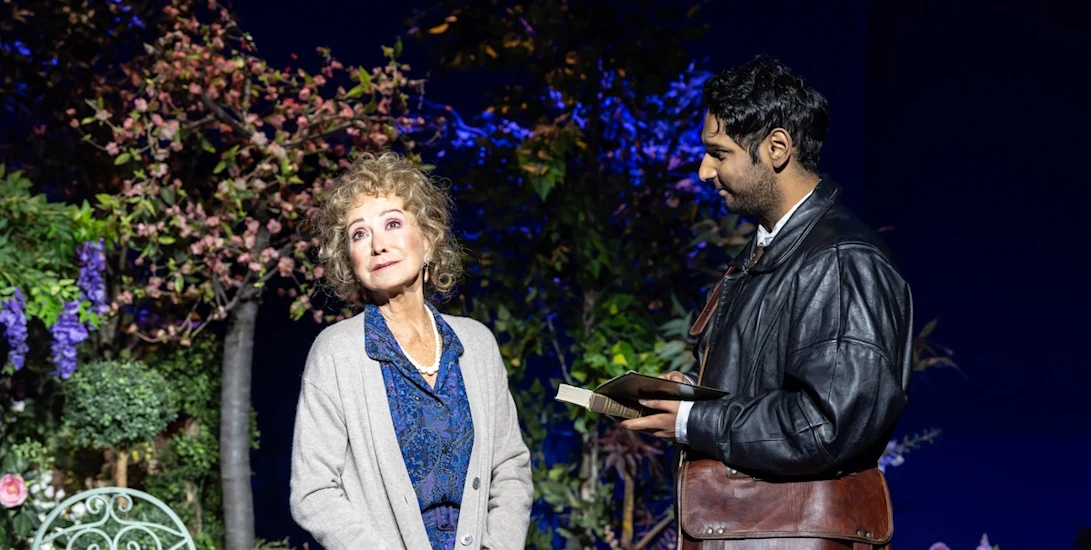
Leslie Travers’s gorgeous, vegetation-heavy set follows on from Into the Woods last week in making London’s stages very green, indeed. So you can understand the ease with which Kendal’s peppery Eleanor is seen in the mid-1980s taking to her suburban London garden, proffering cake to various inquisitors who are trying with mixed success to make sense of Flora’s too-short life. (Among them is an earnest, bumbling American academic because – well, in Stoppard-land can there be any other kind?)
Flora, in turn, is winning hearts and turning heads in 1930s Jummapur, a fictional Indian hill station to which this ever-sunny presence has travelled for reasons of health. Courted by all and sundry, she captures the eye of both the local painter, Nirad Das (a really lovely performance from Gavi Singh Chera), and a hearty if romantically cautious English official (Tom Durant-Pritchard) who takes her riding. Peter Mumford's elegant lighting abets changes in mood throughout.
Issues of nationalism and allegiance to country flare up now and again, as the play's sizable Indian contingent square their own Anglophilia (or sometimes not) with issues of colonisation and cultural appropriation. But the production handles the simmering politics of the piece with an even hand.
It also knows enough to know where the emotional stakes of the material now reside: in the radiant Ashbourne Serkis, a find if ever there was one, and her predecessor in that very role, Kendal, who was given this play by the same author to whom she now returns it with love and respect and a collective lump in the throat, I suspect, involving us all.
Indian Ink is at the Hampstead Theatre to 31 January 2026. Book Indian Ink tickets on LondonTheatre.co.uk.
Photo credit: Indian Ink (Photos by Johan Persson)
Originally published on
Latest News
- 1
First cast revealed for reimagined one-part 'Harry Potter and the Cursed Child' in the West End
- 2
Amber Davies to star in West End run of 'Legally Blonde The Musical'
- 3
New casting announced for 'Witness for the Prosecution'
- 4
'My Neighbour Totoro' announces closing date in the West End
- 5
'Sunday in the Park with George' London revival cancelled
- 6
Complete cast set for 'The Jungle Book' at the National Theatre
- 7
StarKid musical 'Nerdy Prudes Must Die' to play in the West End
- 8
Charlotte d'Amboise to join Jesse Tyler Ferguson in 'Tru' at the Menier Chocolate Factory
- 9
Get to know the new cast of 'Hadestown'
- 10
Complete cast announced to join Keira Knightley, Stephen Dillane, Luke Thompson in 'The Lives of Others'
Subscribe to our newsletter to unlock exclusive London theatre updates!
- Get early access to tickets for the newest shows
- Access to exclusive deals and promotions
- Stay in the know about news in the West End
- Get updates on shows that are important to you
You can unsubscribe at any time. Privacy Policy