

Sir Tom Stoppard — a playwright for the ages
Sir Tom Stoppard, writer of plays including Rosencrantz and Guildenstern are Dead, Arcadia, and The Real Thing, has passed away at the age of 88.
Summary
- Sir Tom Stoppard has passed away at the age of 88
- He wrote plays including Rosencrantz and Guildenstern are Dead and Arcadia
- Indian Ink is set to open at Hampstead Theatre while Arcadia will open at the Old Vic
I will never forget the date: it was 13 April, 1993, and critics were summoned to the National Theatre to collect an advance copy of that night’s opening in the Lyttelton auditorium.
Such summonses are rare but then not every play folds into its capacious discussion the likes of Fermat’s Last Theorem, Capability Brown, and the correct pronunciation of the gardening term “ha-ha”. I returned that evening for the premiere of what was, of course, Tom Stoppard’s Arcadia and emerged three hours later in a rare state of exhilaration that comes from experiencing a new play that had instantly identified itself as an indisputable masterpiece.
I’ve seen Arcadia multiple times since and eagerly await its forthcoming revival at the Old Vic, directed by Carrie Cracknell. But the news of its author’s death, age 88, at the weekend (29 November) hit me and many I know like a thunderclap.
Stoppard has long been correctly venerated as a maverick mind, but in my experience only Stephen Sondheim rivals Stoppard in coupling intellectual wizardry with an ability to aim directly to the heart. Passion coexists with erudition, which surely accounts for Stoppard’s history-making status as the playwright to have won the most Tony Awards – five in all, stretching from 1968 and his first Broadway play, Rosencrantz and Guildenstern are Dead, through to his last Leopoldstadt, 55 years later. Arcadia, oddly, is among his Broadway entries that didn’t take the top prize. And that's not even mentioning the three Olivier Awards he won on this side of the pond.

My first-ever Stoppard production was as a teenager in London in 1978, at a performance of Every Good Boy Deserves Favour at the Mermaid Theatre, the play that Stoppard – in no way musical – wrote for the London Symphony Orchestra at the request of its then-principal conductor, André Previn.
A caprice on a grand scale (not many plays make use of a full-sized orchestra), the show was conceived in the same spirit of intellectual enquiry and adventure that marked this writer’s early work. The Real Inspector Hound draws on the young Stoppard's experiences as a theatre critic in Bristol, while Artist Descending a Staircase, written first for radio and then adapted for the stage, goes backwards from 1972 to 1914 and then forwards again: an instance of theatrical origami inspired – how could it be otherwise for this writer? – by a Marcel Duchamp painting.
Where, though, was the emotion – the capacity for feeling that lifts text from an intellectual puzzle to something you feel in your soul? Perhaps it was there all along.
Rosencrantz and Guildenstern are Dead is one of the most celebrated of all Edinburgh Festival Fringe premieres. The best productions locate the meditation on mortality that we find in existential vaudeville, such as Samuel Beckett's plays. In its own distinctly playful way, R&G are Dead — a riff on two supporting players from Hamlet — peers into the same abyss as Shakespeare’s tragedy.
But it was the 1984 Broadway premiere of The Real Thing that sealed the deal that Stoppard could honour both head and heart. Starring Jeremy Irons and Glenn Close in superlative (and jointly Tony-winning) form, the show follows a playwright possessed of ceaseless wit and dazzle who finds himself wounded to the core. Its eleventh-hour cri de coeur – “please please please don’t” – contains the most emotionally naked appeal imaginable, next to which the dramatist Henry’s verbal finesse is seen to fall away.
The Real Thing is often revived, most recently by Max Webster at the Old Vic in autumn 2024. But I’ve been as moved over time by Jumpers, which surrounds a moral philosopher called George with a troupe of lissome acrobats who give flesh to Stoppard’s metaphysical enquiry, and Travesties, which follows minor consular official Henry Carr: as an older man reminiscing about Zürich during the First World War and, in his younger years, starring in an amateur production of The Importance of Being Earnest.

Lenin, James Joyce and the Dadaist poet Tristan Tzara are among the actual people who feature in the play. That assemblage of notables suggests Travesties as a dry run for both the wounding The Invention of Love, focused on older and younger versions of the poet and classicist AE Housman, and Stoppard’s nine-hour triptych, The Coast of Utopia, whose Broadway premiere at Lincoln Center came with articles helping to unpack its decades-spanning view of 19th-century Russian intelligentsia. These study guides weren’t entirely to the liking of the author, who quite rightly argued that his play, if written well, should stand on its own.
His 2015 National Theatre play, The Hard Problem, seemed to pay reference – oblique or otherwise – to some people’s sense of Stoppard as a writer requiring homework of his audience. That thought was anathema to a man who, in my occasional conversations with him, always gave off an abiding modesty, as well as deep and real kindness.
The subject himself of an exhaustive biography by Hermione Lee, Stoppard more than once made biographical pursuit one of his themes: in Arcadia, but also its immediate successor Indian Ink, due for revival this month at Hampstead Theatre. The same north London venue in 2015 mounted a definitive revival of Stoppard’s espionage-themed Hapgood, another play that – like Arcadia, The Real Thing, and Indian Ink – originally starred the playwright’s onetime muse, Felicity Kendal. She will lead the return of Indian Ink, albeit in a different role from 30 years before.
A man made by and for the theatre, Stoppard won an Oscar for his screenplay (co-written with Marc Norman) of Shakespeare in Love, and he was tapped to script an animated film of Cats that had been planned for Steven Spielberg – and never happened. It speaks to his innate sense of theatre that few of his plays ever made it to the screen, the exception being a 1990 film of R&G are Dead, with Gary Oldman and Tim Roth, directed by the author.

And though he was rumoured to have been working on a play about the financial climate, his last work remains the Olivier and Tony-winning Leopoldstadt, which was also his most personal – a large-cast, commercially audacious venture (courtesy of West End superproducer Sonia Friedman) that brings a novelistic density to its prismatic view of the Holocaust and European Jewry. Stoppard had mined his Czech origins before, in plays like Rock ‘n’ Roll, but Leopoldstadt laid the playwright bare in direct opposition to the youthful brio of his early work, which held his own past very much at arm’s length.
Steeped in the grievous reality of genocide, Leopoldstadt in its own way rewrites the question “How can we sleep for grief?” that gets posed by the brilliant young Thomasina Coverly, the maths protegée, at one point in the fictional terrain of Arcadia. The answer lies in our ongoing gratitude for the work of this extraordinary one-off playwright.
Sir Tom Stoppard: 3 July 1937 - 29 November 2025.
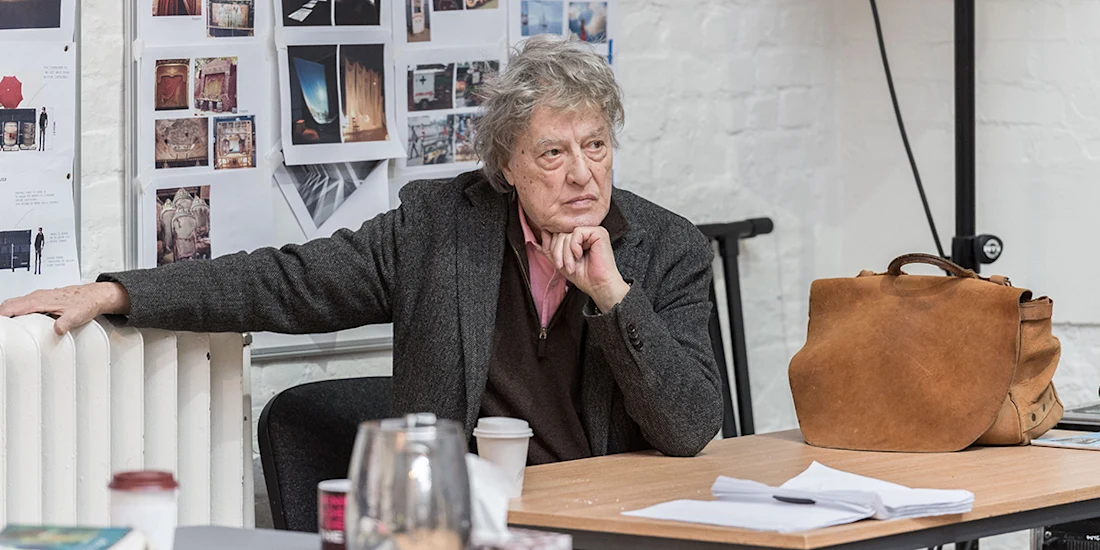
Photo credit: Stoppard in rehearsals. (Photo by Manuel Harlan). Inset: James McArdle and Bel Powley in The Real Thing; Adrian Scarborough in Leopoldstadt; Joshua McGuire and Daniel Radcliffe in Rosencrantz and Guildenstern are Dead. (Photos by Manuel Harlan and Marc Brenner)
Originally published on
Related articles





Subscribe to our newsletter to unlock exclusive London theatre updates!
- Get early access to tickets for the newest shows
- Access to exclusive deals and promotions
- Stay in the know about news in the West End
- Get updates on shows that are important to you
You can unsubscribe at any time. Privacy Policy