

Learn more about the academic theories in Tom Stoppard's 'Arcadia'
From chaos theory to Classicism and Romanticism, this hit West End play is teeming with incredible ideas.
Summary
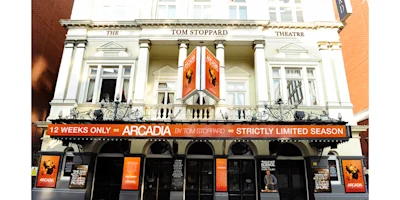
- Tom Stoppard's Arcadia is playing at the Duke of York's Theatre in the West End
- The play explores numerous academic ideas such as chaos theory
- He also pits Classicism against Romanticism
- These ideas are both discussed in the play and used metaphorically to brilliant effect
Tom Stoppard’s landmark play Arcadia, currently enjoying a hit revival in the West End, is teeming with ideas. That makes it a hugely engaging watch, as his characters’ erudite, witty and thought-provoking conversations range from mathematical and scientific theories to philosophy, poetry, landscape gardening, and love, making fascinating connections along the way.
Audiences can absolutely enjoy the play without knowing anything beforehand. But if you would like to learn a bit more about some of the theories involved, and how they’re used in the play, read on for a handy Stoppard primer.
Book Arcadia tickets on LondonTheatre.co.uk

Chaos theory
One of the main throughlines in Arcadia is the tension between chaos and order. That is part of the form of the play: seemingly unconnected conversations and events – including scenes taking place in two different time periods, the early 19th century and the late 20th century – gradually coalesce into a cohesive whole. That represents deterministic chaos: complex patterns but with an underlying order. We also see how small actions in the story have unpredictable, unforeseen consequences, which is a different element of chaos theory.
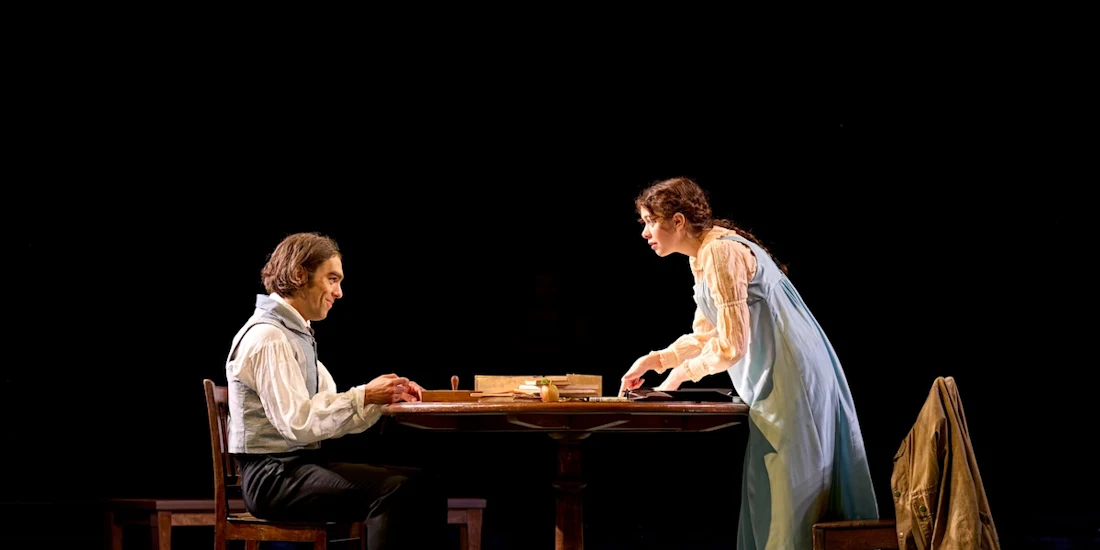
The characters discuss the mathematical concept of chaos theory in the course of the play too. Early on, the 13-year-old prodigy Thomasina Coverly, who is being tutored by Septimus Hodge in the 19th-century timeline, uses the analogy of stirring jam into her rice pudding, then muses on how elements of nature, like leaves and clouds, are chaotic shapes rather than adhering to geometric patterns.
Later, in the modern timeline, author Hannah Jarvis, academic Bernard Nightingale, and maths graduate student Valentine Coverly study Thomasina’s work – including her thoughts about chaos theory, which hadn’t yet been established – and come to realise her genius.
Fermat’s last theorem
The 17th-century French mathematician and polymath Pierre de Fermat is perhaps best known for his so-called last theorem. It’s a number theory that there are no positive integers, and he wrote in the margin of another work, Arithmetica, that he had the proof of the theorem but it was too big to fit in the margin. Over hundreds of years, other mathemeticians have tried to prove this unsolved problem, with Andrew Wiles finally succeeding in 1995.
In Arcadia, Septimus sets Thomasina the task of proving Fermat’s last theorem, though she savvily posits: “There is no proof […] The note in the margin was a joke to make you all mad”. Just the mention of this famously impossible theorem helps us understand the astonishing level of Thomasina’s intellect (in fact, when the play premiered in 1993, the theorem was still yet to be solved).
It also represents another important theme in the play: the intrigue of unsolved mysteries. In the present day, the academics are obsessed with discovering what really happened in the past – Hannah wants to know the identity of a hermit who lived in the grounds of the Coverlys’ house, while Bernard wants to prove his theory that Ezra Chater, who also lived there, was killed by the poet Bryon in a duel. These and various other threads gradually unspool over the course of the story as the past and present converge.

The second law of thermodynamics
Thomasina also uses her jam and rice pudding experiment to explore the second law of thermodynamics – a scientific principle stating that heat flows from a hotter area to a colder one, but not in the opposite direction. A related concept is entropy: that systems irreversibly move from disorder to order. Thomasina draws a diagram relating to the heat death of the universe – a scientific theory about the ultimate fate of the universe.
Stoppard uses these ideas in metaphorical terms to explore how time moves in one direction and we cannot evade our fate, or undo certain actions. Nor can we escape growing older, or escape death. As for the characters in the present-day story, they long to connect with the past, but some of it will always elude them: they cannot go backwards, and some of the information is lost to them.
It’s fascinating for the audience to see the two stories, and to gradually come to a greater understanding of the past than the academics ever can. We also learn a key piece of information about Thomasina’s future, which colours everything we see of her from that one point onwards, since we know what will irreversibly happen.
Classicism vs. Romanticism
This is another major throughline in Arcadia, pitting two rival schools of thought against one another. Classicism, which relates back to the classical era of Ancient Greece and Rome, but is also associated with the Age of Enlightenment, is characterised by logic, reason, symmetry in architecture and design, scientific curiosity, and emotional restraint and control.
Romanticism, by contrast, was a rejection of the Age of Enlightenment and the industrial age, instead embracing the wildness and pleasures of nature, individual thought and freedom, boundless imagination, the enjoyment of mystery and a sense of the divine or sublime, and emotional passion.
In Arcadia, that tension plays out in numerous ways. Thomasina and Septimus are more on the Classicism side, prizing reason, rationality and education, but Lord Byron is also a key figure, representing the fiercely Romantic side of the equation, from his poetry to his colourful private life. Like the latter, we see several characters giving into desire, love, anger, and jealousy.
The house itself, Sidley Park, is almost a character too. Lady Croom (Thomasina’s mother) argues with gardener Richard Noakes about his plans for the grounds. He wants to transform the formal gardens, whose geometric design suggests Classical order, into the more fashionable, and more picturesque, Gothic style (Romantic). But since the latter is planned, it’s not totally wild either. Likewise, the play suggests that there is in fact no strict divide between the two schools: science blurs with art, intellect with imagination, and reason with passion.
Book Arcadia tickets on LondonTheatre.co.uk
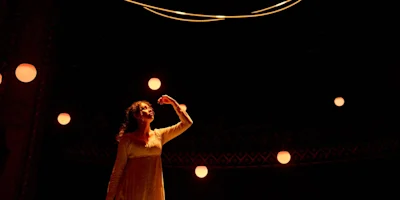
Photo credit: Arcadia (Photos by Manual Harlan)
Originally published on
Latest News
- 1
Amber Davies to star in West End run of 'Legally Blonde The Musical'
- 2
First cast revealed for reimagined one-part 'Harry Potter and the Cursed Child' in the West End
- 3
'My Neighbour Totoro' announces closing date in the West End
- 4
'Sunday in the Park with George' London revival cancelled
- 5
Complete cast set for 'The Jungle Book' at the National Theatre
- 6
StarKid musical 'Nerdy Prudes Must Die' to play in the West End
- 7
Charlotte d'Amboise to join Jesse Tyler Ferguson in 'Tru' at the Menier Chocolate Factory
- 8
Get to know the new cast of 'Hadestown'
- 9
Complete cast announced to join Keira Knightley, Stephen Dillane, Luke Thompson in 'The Lives of Others'
- 10
Megan Hilty and Rachel Tucker to star in concert production of 'Gentlemen Prefer Blondes'
Related articles
Subscribe to our newsletter to unlock exclusive London theatre updates!
- Get early access to tickets for the newest shows
- Access to exclusive deals and promotions
- Stay in the know about news in the West End
- Get updates on shows that are important to you
You can unsubscribe at any time. Privacy Policy