'Under the Shadow' review — this supernatural Iranian war horror is the stuff of nightmares
Read our review of Under the Shadow, adapted from Babak Anvari’s film, now in performances at the Almeida Theatre to 4 July.
Summary
- Babak Anvari's horror film Under the Shadow is adapted for the stage
- Carmen Nasr's version is likewise set in 1980s Tehran
- Nadia Latif's production features jump scares but less mental unravelling
- The cast features a fiercely compelling Leila Farzad

The set-up is, at its chilling core, a familiar one: a mum and her daughter are trapped inside a house that’s showing increasing signs of being haunted. There’s a flicker of the lights here, a flash of something moving over there, and things are mysteriously disappearing. But add to that the backdrop of the Iran-Iraq War, which in 1988 saw a final showering of missiles rain down onto the Iranian capital of Tehran, and the psychosis experienced by those living under siege is entirely credible. Under so much external threat, even the most rational mind could start to believe there must be evil spirits – bad djinn, as they’re known in Middle Eastern mythology – behind it.
Babak Anvari’s film, on which Carmen Nasr’s stage adaptation is based, is a subtly powerful portrait of its themes. An Iranian war horror, it is also a feminist account of the aftermath of the Iranian Revolution, which stripped women of their liberties, forced them to wear headscarves in public, and punished those who protested.
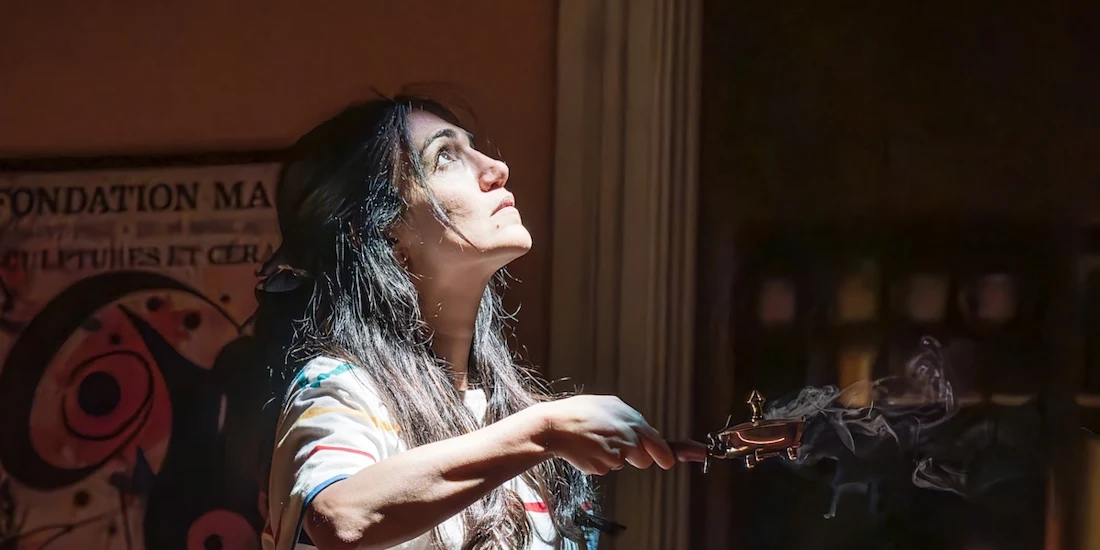
Its lead, Shideh (Leila Farzad), is mourning the medical degree she was banned from completing and resenting her life as a stay-at-home mum while her husband is out in the world practising the profession they both studied for. Farzad is fiercely compelling as a should-be modern woman with a penchant for Jane Fonda workouts, who can only be herself behind closed curtains. Stifled and diminished, her push-pull relationship with daughter Dorsa (Erin Jemmotte on press night) is entirely relatable.
Opposite her, the role of Dorsa brings big responsibility for any child actor still shy of their teens, but Jemmotte is convincing as the little girl made drippy by her fever, never missing a line and knowing exactly where and when to dart across the stage.
The film is a quiet masterpiece but not all of its clear-eyed poignance translates to the stage. Directed by Nadia Latif, a languid first half relies on exposition to portray moments the movie achieved with little more than a glance.
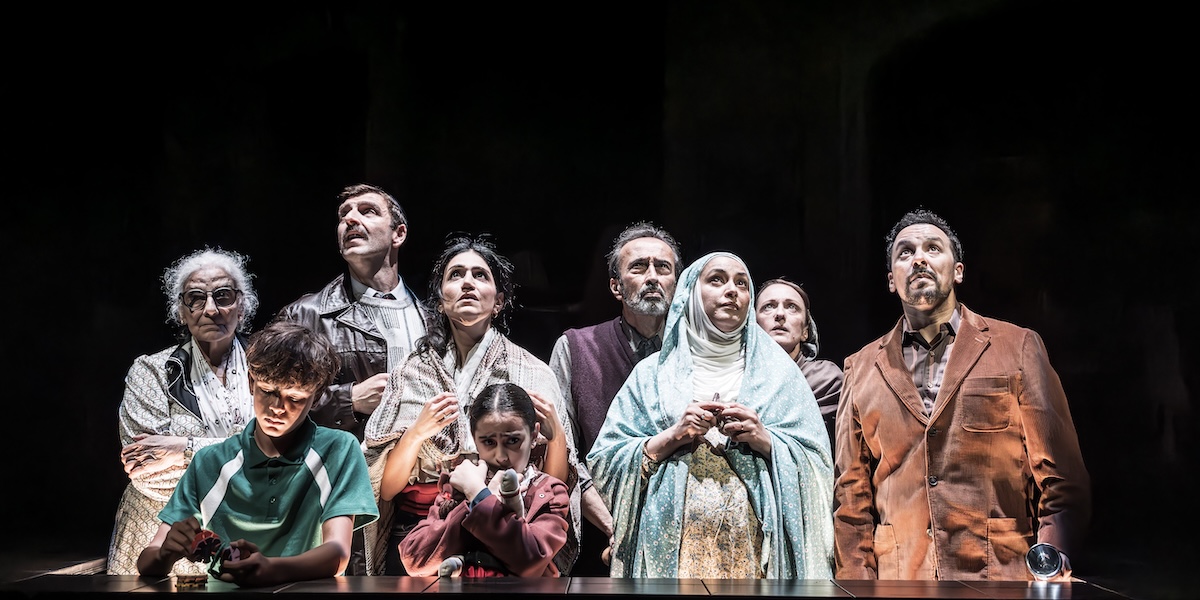
Still, its longer runtime allows for Shideh’s relationships with peripheral characters to come into focus. Beyond her husband, a not entirely sympathetic Iraj (Nicholas Karimi) who gets sent to the frontline early on, there’s the intensely superstitious Mrs Ebrahimi (Mona Goodwin), begrudgingly caring for PTSD-suffering orphan Mehdi (Rohan Berry), who was written off by his extended family as ‘creepy’. Also in the apartment complex is voice of reason Mrs Fakur (Souad Faress), Shideh’s rock.
Shideh’s mental unravelling is not as pronounced as it is in the film, and I'd argue that presenting the horror as purely exterior undermines the notion of a character driven mad by regime change and war. But there are jump scares fit to make you rise several inches from your seat as the djinn starts to make its presence known. Nasr’s adaptation resists recreating the scream-worthy moments from the film, but with the help of illusion consultant Scott Penrose, it’s perfectly frightening.
Ben Stones’s design uses the stage effectively too: a naturalistic open-plan living space decorated with warm walls and midcentury furnishings centres the drama in the family home, while there’s room at the front for scenes that take place in the bunker, where the residents huddle together during bomb raids. As a missile strikes the building’s roof, its smoking girth appears to pierce the top of the stage like a dagger into skin.
Anvari’s near-perfect film would be almost impossible to do justice to on stage, but Shideh’s conundrum remains the stuff of nightmares.
Under the Shadow is at the Almeida Theatre to 4 July.
Photo credit: Under the Shadow (Photos by Marc Brenner)
Originally published on
Subscribe to our newsletter to unlock exclusive London theatre updates!
- Get early access to tickets for the newest shows
- Access to exclusive deals and promotions
- Stay in the know about news in the West End
- Get updates on shows that are important to you
You can unsubscribe at any time. Privacy Policy